Average Reviews:

(More customer reviews)I completely rewrote this review after getting the chance to compare this flash to a Nikon SB-600. They are in the same price range, so I guess most people who look at this item are wondering if they should get the Promaster over the Nikon, as it offers higher specification numbers. The answer is: it depends. Overall you get more for the money, but there are also some little problems you buy with this third party flash and some features only Nikon flashes have.
Built quality/design:
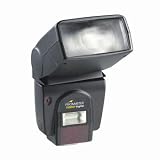
The Promaster is quite a bit bigger than the Nikon. The flash end itself has more than 1.5 times the surface than the Nikon. The Promaster also has the second flash head. With the main head bounced and the second flash turned on, you get relatively "safe" results similar to using a bounce card or a bulb diffuser, maybe a bit more direct fill than with a bulb diffuser. The flash is well built, with a metal shoe. It doesn't lock the flash head position like the Nikons and feels a bit more lose, but it is stable enough. Mine just recently survived a 5 foot drop onto concrete without any problems. The Promaster tilts and swivels in all possible directions (including a bit downwards) which is very important in my opinion (The Nikon SB-600 is missing 90° swivel between 90 and 180°. If you like to bounce on-camera flash, this is a deal breaker for the Nikon). Bouncing backwards is also easier due to the size (the Nikon tends to bounce from my forehead when aimed backwards). On the other hand, the Promaster is realtively big and doesn't balance to well on a smaller SLR.
Power, recycling time, battery life:
The Promaster is about as powerful as the Nikon SB-600. The higher guide number compared to the SB-600 is only the old marketing trick of using a different zoom position. Doing a quick comparison, I think the Promaster might be about one third stop more powerful. On the other hand the Promaster zooms further in (to 105mm) which gives it more effective power with longer focal lengths. At full power it recycles a bit slower than the SB-600. In most real life shooting situations with powers of 1/4 or less, both flashes are fast. Battery life is a bit of an issue with the Promaster. Normal AA batteries actually last quite a while, but the recycling time of the flash slows down really fast, and then it is a pain to use it. With the newer Lithium batteries, I don't have this issue any more. I am about to change to NiMH and will add my impression of that to the review.
On-Camera use:
This is what this flash was built for and where it works best. TTL works just fine. Especially if you bounce flash, you sometimes need to play with the flash exposure compensation to get the exposures, but that's similar with Nikon flashes. On the Promaster you cannot set the FEV. You have to do it on the camera, giving you only + 1 stop (and -3).
Unfortunately it doesn't support Nikon's "FP" mode, i.e. Nikon's high speed sync for shutter speeds over sync speed, which works quite well with the Nikon SB-600 for close range daylight shots were you want that wide aperture and add some fill.
There is a compatibility issue with the Nikon system: When I turn off the flash while it is mounted on my D90, the camera works fine in the beginning. But when I try to wake up the camera after the display readings turn off by touching the shutter button, it stays asleep. I have to turn on the display light, or turn the camera off and on again, or turn on the flash, to wake up the camera. If you only want to take one picture without flash, it's not a big deal. If you like to turn your flash on and off all the time while shooting, this will become annoying.
Wireless off-camera use:
The wireless mode of the Promaster is OK, not great. It basically an optical slave that can only be triggered by Nikon's CLS, but only works with manual flash output, no TTL. Under ideal conditions you can control it with the (on-camera flash) commander mode of a D90, also when the on-camera flash output is turned way down. It doesn't work as optical slave outside Nikon's CLS. The sensor best picks up triggering flashes that hit the bottom part of the flash from the front. But over all, it is not very reliable, and if the batteries are getting old, you can completely forget it. The Nikon SB-600's response is way, way better.
A radio trigger or any other method will not solve this problem easily. There is no PC or whatever plug and the central pin does not control the manual flash alone. Actually it does, but only once, and then the flash cannot be fired again. You can build a customized adapter that shorts some of the pins to make it work - I just don't know if the flash is actually okay with that on the long run. Promaster is about to release cheap radio triggers - maybe they will be an option - but only if they work with other flashes as well.
In summary, the Promaster 7500edf is a capable TTL flash for Nikon DSLRs. It is a bit big and feels a bit cheaper than the Nikon, but on the other hand has everything it needs for on-camera use. For this it works perfectly, as long as you don't turn it off. When you do that or even take it off camera, you start running into compatibility issues.
Despite these issues, the zoom range and 360° swivel give it a significant advantage over the Nikon SB-600 in my opinion (which is otherwise a smaller and nicer flash).
For sure not a perfect product, but it is an acceptable compromise to the similarly priced first party product, which is also not perfect. For the flash itself I would give 3 points. The fact that you have to pay about the double to get a Nikon flash that swivels 360° gives this Promaster flash a 5 star value. Therefore overall 4 stars.
Click Here to see more reviews about: Promaster 7500EDF Digital Flash - Nikon
Product Description:
The PROMASTER 7500EDF Digital is a fully dedicated TTL flash designed to work seamlessly with today's high tech digital SLRs as well as traditional SLRs. It includes many advanced features including motorized zoom, multiple and modeling modes, and remote slave function. Along with all of these great features, you get full TTL integration with your digital SLR. The flash has a low profile design, a metal flash foot and features the added benefit of being able to update the firmware which insures that you will get many years of reliable flash photography. One of the handicaps of a camera (film or digital type) is the need to have good light to make a great picture. Many of today's cameras can take pictures indoors without flash or offer a built in electronic flash. However, adding more light in just the right amount can make the difference between a good picture and a remarkable picture. When you see pictures taken by today's contemporary photojournalists, the definition and tonality of the picture can be awesome. Accurate color, sharp detail and balanced illumination are important parts of great photography. And while some people still think film cameras make better pictures than digital, many who are shooting digital know that their pictures easily rival those shot on film. The biggest limitation to a digital camera is the sensitivity of the image sensor. Even though you can adjust the film speed setting on your digital camera, you really are only adjusting the software. Setting the ISO does not really change the ability of the camera's sensor to absorb light. It is more like tuning the color and contrast control on a television. The one tool that will dramatically improve your photographs is the PROMASTER 7500EDF Digital flash.

Want to read more honest consumer review about Promaster 7500EDF Digital Flash - Nikon now ?
